
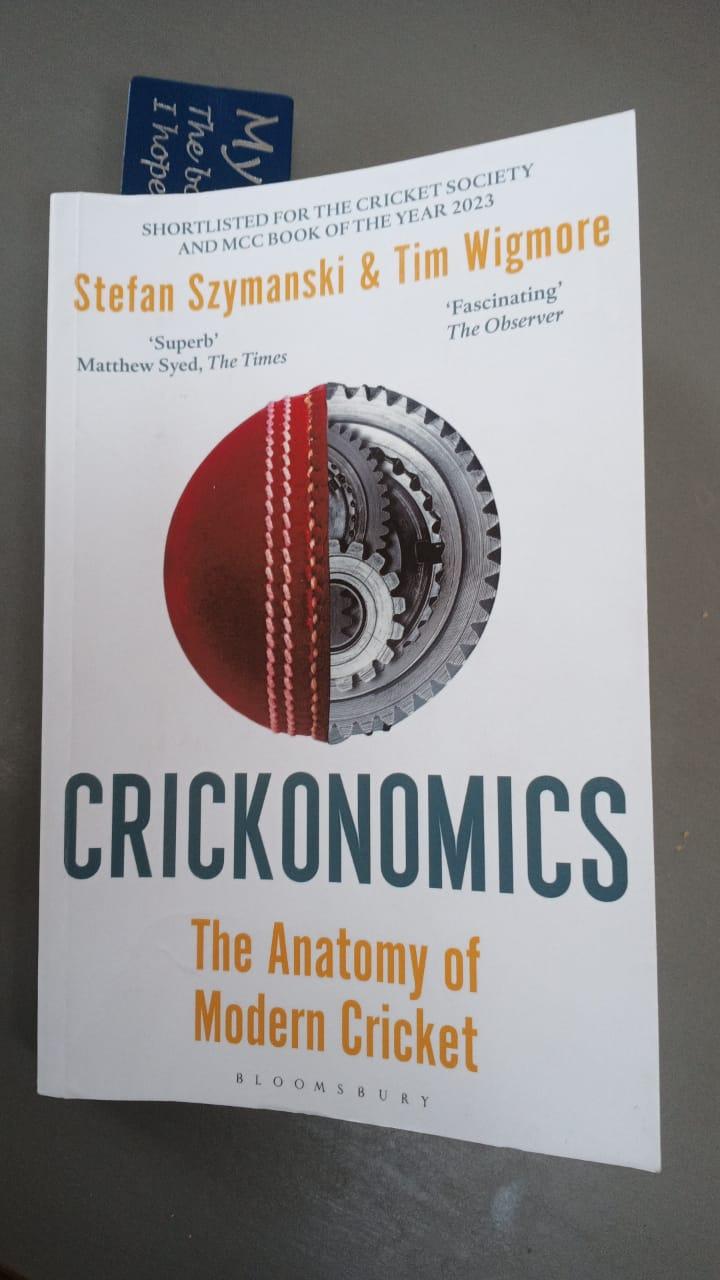
This is a comprehensive analysis of the current state of the game and the finances and players behind it. There are some surprises unearthed and some obvious home truths.
Statistics for breakfast. Regression Analysis for lunch, and IPL / NBA comparing and contrasting for post clubbing bacon butty.
I liked it. Even for a lifetime cricket fan, there were many facts and figures that were totally new to me. It deserves MCC Book of the Year 2023 imho. The front cover picture which is half cricket ball, half metal cogs and mechanism is spot on. It’s an intricate, warp and weft account. Admittedly at times I did think I could be in a sterile board room looking over Profit and Loss spreadsheets, but just as it’s a learned skill to read a scorebook, it is a learned skill to understand money. The book (as its title suggets) unearths the anatomy of the (modern) great game.
Once we’ve moved on from the well trodden, time worn conversations and observations about State/Private school provisions and the chances of becoming a Batsman or Bowler (Stuart Broad here can be classed with the Great Don as being what Mathematicians would call an [out and out] ‘outlier’), we move towards how scoring rates have changed.
One of my favourite lines in the book? “It is a myth that the rise in run rates in Test cricket was influenced by T20. Instead, the surge in Test scoring rates foreshadowed the invention of the new format”. Deep praise, for the pinnacle of the purest of formats. Naturally, all this is backed up by diagrams even the FT would be proud of. But really, reading between the lines of a ‘Head and Shoulders’ time graph, it all just boils down to Adam Gilchrist of Australia.
There are great insights into how the women’s game was originally an integral part of the fabric and how Afghan refugees are bringing Cricket to Germany. I note they are still laburing in position 35, when the Top 20 (in T20) was originally part of the rhetoric, but they are a long way off Mongolia in position 94. It’s a book that subscribes to the ‘PEE’ way of writing : Point, Evidence, Explain, and as such it’s worked out the exam formula and gets an A minus. A few more amusing anecdotes wouldn’t go a-Dennis Amiss but making money isn’t usually a business of gags and jokes.
There are published IPL salaries, although interestingly Moeen Ali’s take-home pay from the Royal Challenger’s Bangalore is listed as [unknown]. I wonder why? None of any of this is possible without the paying public, and a population that is willing to play. The latter is partly why Bangladesh have entered the Test arena and Kenya not (yet).
Will you be ‘purring with pleasure’ as the Mail on Sunday suggests as you read it? Possibly. The Economics of the Leather and Willow will continue for a long while to come.